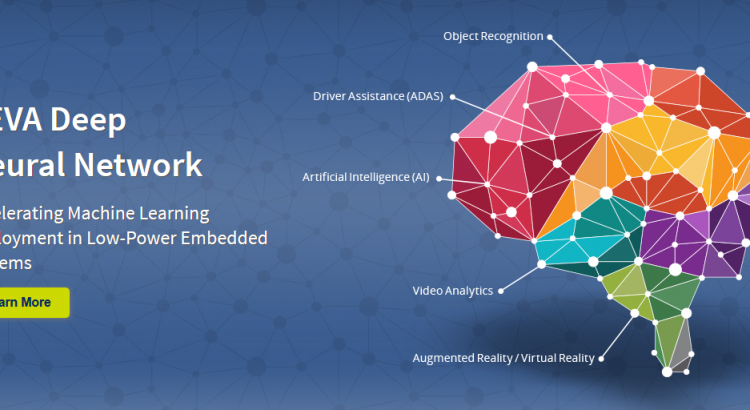
Ceva firmasının kendi gömülü ürünü üzerinde derin öğrenme uygulamalarını nasıl gerçekleştirildiğine dair webinar gerçtiğimiz gün yayınlandı. Tekrar izlemek isteyenler için video ve sunum dosyası aşağıda sunulmuştur.
Kaynak: http://www.ceva-dsp.com
Ceva firmasının kendi gömülü ürünü üzerinde derin öğrenme uygulamalarını nasıl gerçekleştirildiğine dair webinar gerçtiğimiz gün yayınlandı. Tekrar izlemek isteyenler için video ve sunum dosyası aşağıda sunulmuştur.
Kaynak: http://www.ceva-dsp.com
Dato’nun online eğitim olarak düzenlemiş olduğu derin öğrenme kullarak “Benzer Resimleri Bulma” derslerini kaçıranlar veya tekrar izlemek isteyenler aşağıdaki bağlantılardan ilgili içeriğe ulaşabilirler.
Derin Öğrenme: Bölüm 1 / 2:
Derin Öğrenme: Bölüm 2 / 2:
Gelecek webinarlar:
This paper envisions an end-to-end program generation scenario using recurrent neural networks (RNNs): Users can express their intention in natural language; an RNN then automatically generates corresponding code in a character by-character fashion. We demonstrate its feasibility through a case study and empirical analysis. To fully make such technique useful in practice, we also point out several cross disciplinary challenges, including modeling user intention, providing datasets, improving model architectures, etc. Although much long-term research shall be addressed in this new eld, we believe end-to-end program generation would become a reality in future decades, and we are looking for ward to its practice.
In this paper we describe a fast and accurate pipeline for real-time face recognition that is based on a convolutional neural network (CNN) and requires only moderate computational resources. After training the CNN on a desktop PC we employed a Raspberry Pi, model B, for the classication procedure. Here, we reached a performance of approximately 2 frames per second and more than 97% recognition accuracy. The proposed approach outperforms all of OpenCV’s algorithms with respect to both accuracy and speed and shows the applicability of recent deep learning techniques to hardware with limited computational performance.